Skip to content

Aidan Li

Research engineer finishing an MSc at Mila. I have two NeurIPS papers and a journal paper in multiple different topics (dynamical systems, LLM RL for safety, MCMC). I also have prior industry internships building real-world ML systems, one of which led to a patent application.

Looking for a research engineer or member of technical staff role starting in summer or fall 2027.

aidan.li@mila.quebecCVGitHubScholarLinkedInX

My portrait drawn by a Metropolis algorithm. (See About page for a more normal portrait.)
0 proposals · 0.0% accepted

Publications

NeurIPS 2026

Sparse Koopman Autoencoders Identify Local Dynamical Regimes in Multibasin Systems

Aidan Li, Uday Kiran Reddy Tadipatri, Mahan Fathi, Sarath Chandar, Ross Goroshin

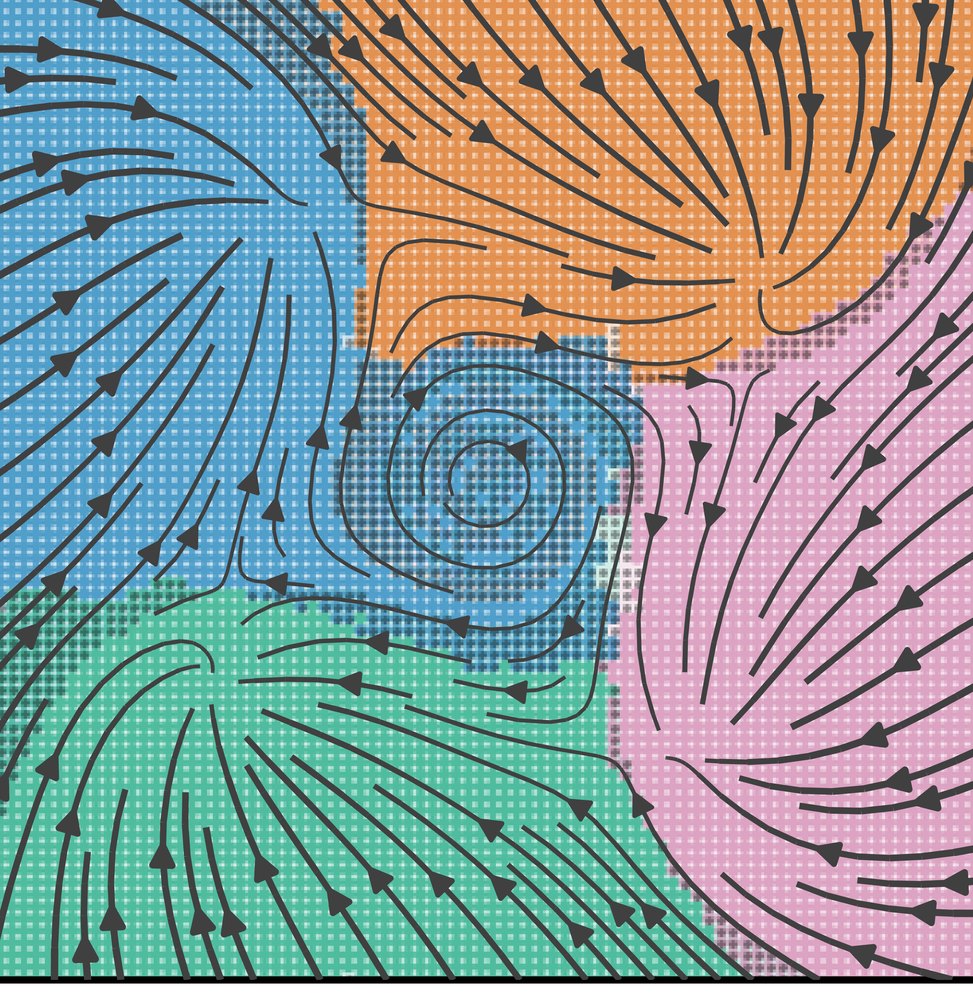
Many dynamical systems have several basins of attraction, and under standard assumptions they cannot generally be captured by a single finite-dimensional global Koopman embedding. We find that training the autoencoder to produce sparse latents allows the set of active latent coordinates to become useful for identifying which basin a state is in, and this also improves forecasting significantly relative to dense-latent autoencoders.
PaperCode

Streamlines of a vector field with four basins of attraction, over a grid of dots coloured in four regions that match the basins.
From Figure 1 of the paper. Grey streamlines are the true vector field of a procedurally generated multibasin system. Coloured dots are states where the model's latent support matches the basin; black dots are mismatches.

NeurIPS 2025

Reducing the Probability of Undesirable Outputs in Language Models Using Probabilistic Inference

Stephen Zhao, Aidan Li, Rob Brekelmans, Roger Grosse

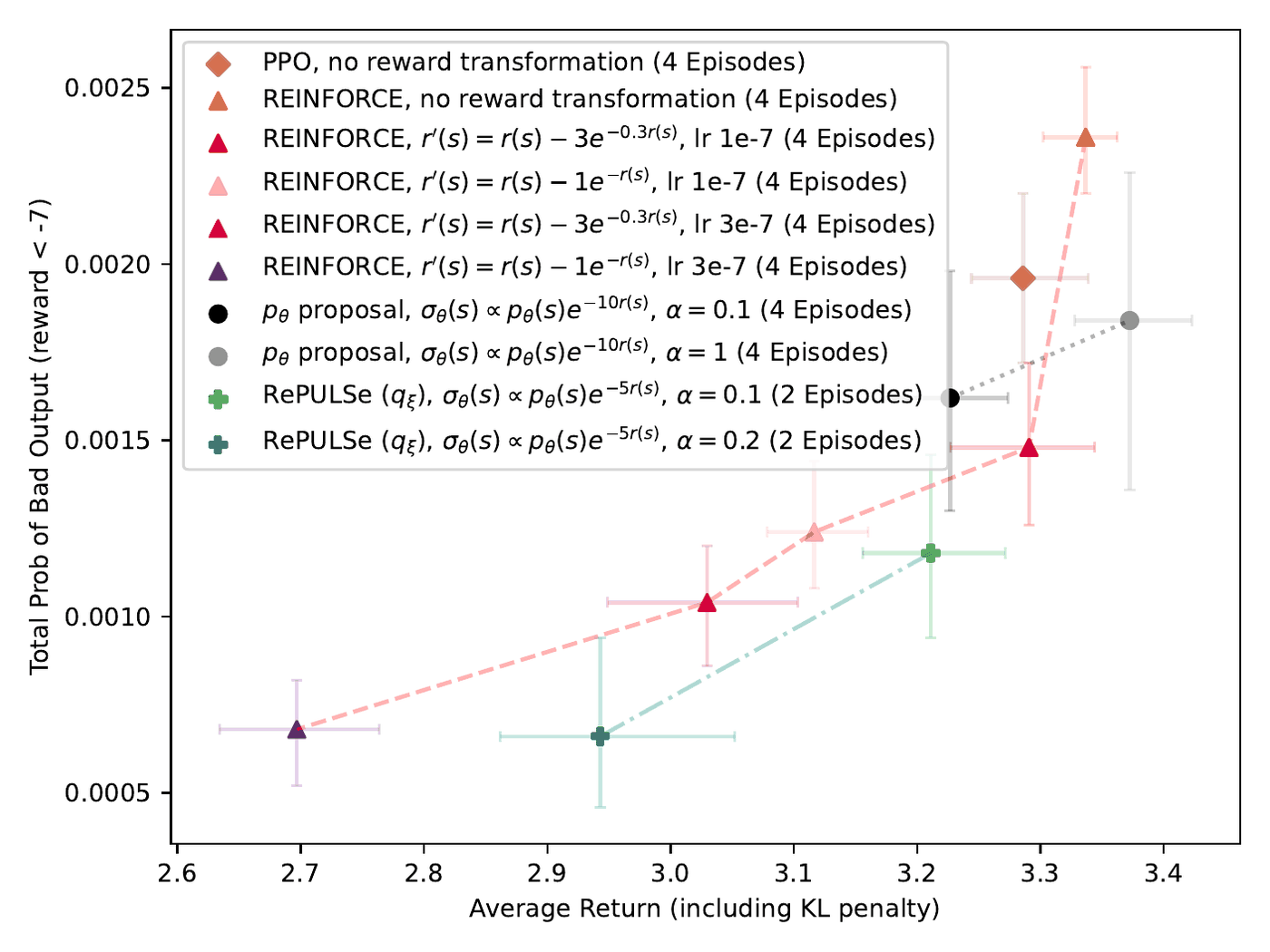
Standard reinforcement learning fine-tuning optimises a language model's average reward, and methods that target its undesired outputs usually cost average performance. RePULSe adds a loss that uses learned proposals to sample low-reward outputs and then reduces their probability. It gives a better trade-off between expected reward and the probability of undesired outputs than standard RL baselines, and is more robust to adversarial attacks.

PaperCode

A scatter plot of training methods: average return on the horizontal axis, total probability of a bad output on the vertical axis. The RePULSe points lie below the baselines' frontier.
Figure 4 of the paper. Each point is a training method averaged over 5 seeds, with 95% confidence intervals: further right is higher average return, lower is a smaller probability of a bad output. RePULSe (crosses) improves the Pareto frontier.

Communications in Statistics - Simulation and Computation, 2025

Exploring the Generalizability of the Optimal 0.234 Acceptance Rate in Random-Walk Metropolis and Parallel Tempering Algorithms

Aidan Li, Liyan Wang, Tianye Dou, Jeffrey S. Rosenthal

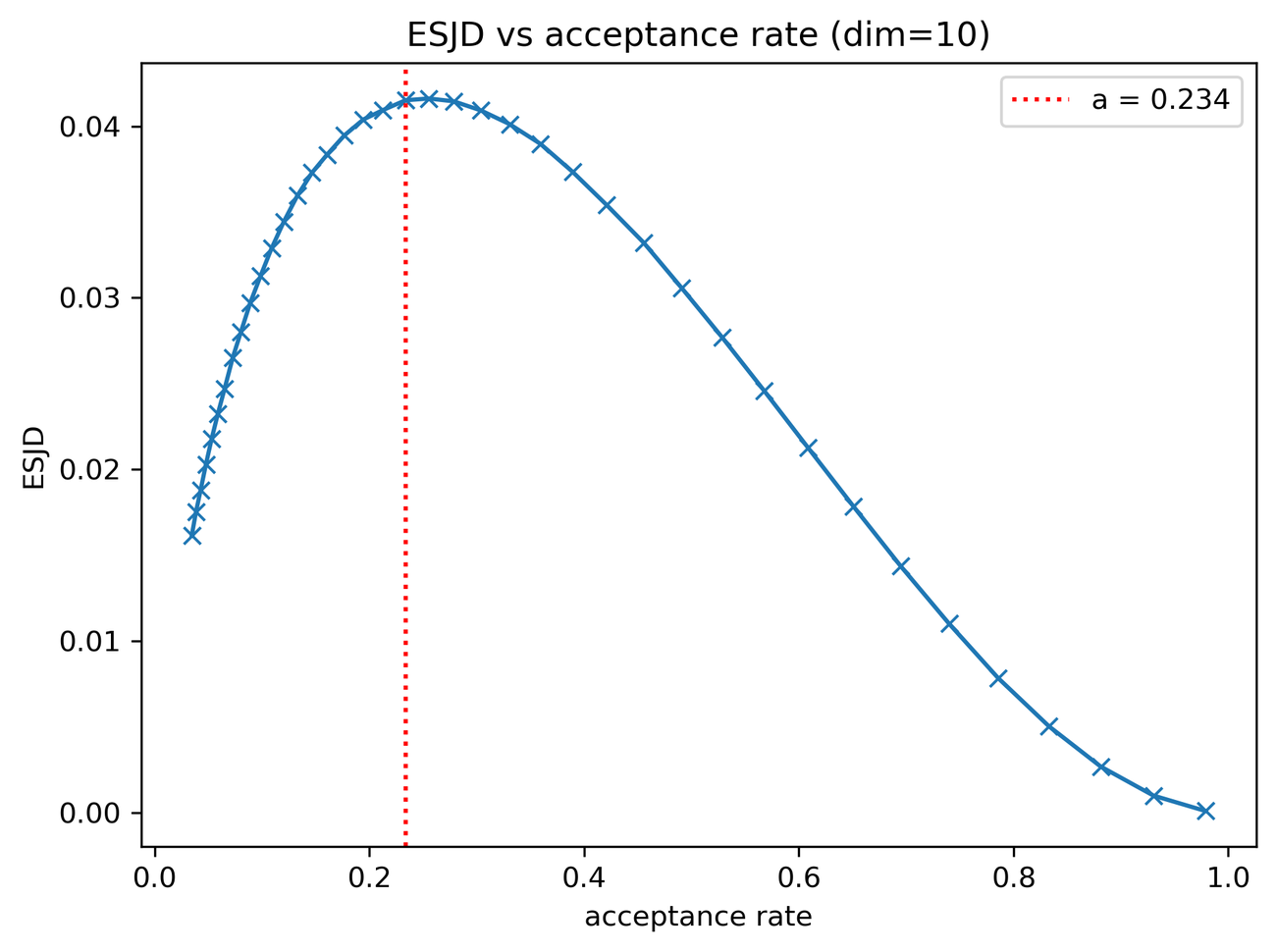
For random-walk Metropolis, an acceptance rate of about 0.234 is known to be optimal in certain high-dimensional limits. We tested how far that holds with a large simulation study: lower dimensions, non-spherical proposals, multimodal targets and curved Rosenbrock targets. The 0.234 acceptance rate is surprisingly robust, and seems to be practical even for spacing the swap rates of a parallel tempering ladder.

PaperarXivCode

A curve of expected squared jumping distance against acceptance rate in 10 dimensions, peaking close to a dotted vertical line at 0.234.
From Figure 1 of the paper: efficiency (ESJD) against acceptance rate for random-walk Metropolis on an i.i.d. Beta(3, 2) target in 10 dimensions. The dotted line marks 0.234.

Also: Experimenting with Experimentation: Rethinking the Role of Experimentation in Educational Design. Workshop paper, ACM Learning @ Scale 2022.